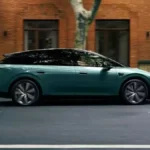


The Xiaomi SkyNomad specs reveal a large extended-range electric SUV (EREV) designed around flexible seating, long electric driving capability, and advanced driver-assistance hardware. The China launch matters globally because it shows how Chinese automakers are combining three-row practicality, LiDAR-based ADAS, and premium cabin technology at prices well below many comparable SUVs in overseas markets.
The new range includes the Xiaomi SkyNomad N70 Max and N90 Max. Pre-sale pricing starts at RMB 259,900, or approximately US$36,100, while the N90 Max starts at RMB 299,900, equivalent to about US$41,650 at an exchange rate of RMB 7.2 to US$1.

Xiaomi SkyNomad Specs and Quick Summary
- Models: SkyNomad N70 Max and N90 Max
- Vehicle type: Large extended-range electric SUV
- N70 Max pre-sale price: RMB 259,900, approximately US$36,100
- N90 Max pre-sale price: RMB 299,900, approximately US$41,650
- Battery capacity: 52 kWh or 76 kWh
- N70 Max CLTC electric range: Up to 505 km
- N90 Max CLTC electric range: 464 km
- N90 Max combined range: Up to 1,705 km
- N90 Max output: 310 kW
- N90 Max drivetrain: Dual-motor all-wheel drive
- Maximum cargo volume: 1,831 liters
- ADAS computer: Thor-U, rated at 700 TOPS
- N90 Max drag coefficient: Cd 0.255
Range, Battery, and EREV Powertrain
The SkyNomad Series uses Xiaomi’s Kunlun Super Extended-Range system. Its combustion engine primarily generates electricity, while electric motors drive the wheels, allowing the vehicle to operate as an EREV rather than a conventional hybrid SUV.
The N70 Max offers up to 505 km of CLTC electric range, while the N90 Max is rated at 464 km. Xiaomi quotes a combined range of up to 1,705 km for the N90 Max, along with fuel consumption of 6.26 L/100 km when the battery is depleted.
CLTC figures are produced under China’s testing cycle and generally exceed results in everyday driving. Real-world range and comparable WLTP figures are typically around 15-20% lower, depending on temperature, speed, payload and road conditions. EPA results in the United States can vary further due to differences in testing methodologies.
Battery capacities are listed at 52 kWh and 76 kWh. Xiaomi says the Longjia battery includes 18 layers of physical protection, 16 layers of thermal-safety protection, and aerogel insulation. The company also claims that the pack is designed to prevent thermal propagation following a single-cell thermal runaway event.

Flexible Three-Row Interior
The SkyNomad is nearly 5.3 meters long and emphasizes configurable interior space. Its flat-floor area exceeds 4.4 square meters, while the flat-floor length approaches 3 meters.
The N90 Max has seat rails extending up to 1,938 mm, with 900 mm of travel for both the second- and third-row seats. Maximum cargo volume is 1,831 liters, and Xiaomi says the seven-seat configuration can carry seven 20-inch suitcases.
Interior modes include seven-seat travel, a four-seat layout, face-to-face seating, flat-bed resting, cargo hauling, mobile office use, and camping. The N90 Max also supports four zero-gravity seats, although that layout cannot be used simultaneously with the rotating front-seat configuration.
A movable center island adds wireless charging, a compressor refrigerator, charging ports, and accessory interfaces. Xiaomi says the cabin has 34 storage locations, and voice commands can switch among 11 space-layout modes.

LiDAR-Based ADAS and Cabin Technology
All versions receive high-specification perception and computing hardware, including Xiaomi’s Thor-U ADAS computer with a claimed 700 TOPS of computing power. Equipment includes integrated and forward-facing LiDAR, 4D millimeter-wave radar and high-transmission anti-glare cameras.
The N90 series adds rear-facing LiDAR, which Xiaomi says can achieve ranging accuracy of up to 2 cm. The system supports advanced parking functions, obstacle recognition, and high-level driver assistance, but the source does not explicitly confirm Urban NOA or High-Speed NOA.
These remain driver-assistance systems, not autonomous driving. Drivers must remain attentive and responsible for vehicle control.
Inside, the SkyNomad features a Snapdragon 8 Gen 3 cockpit platform, dual 5G, Wi-Fi 7, six-screen connectivity and a 25-speaker Xiaomi Star String audio system. The head-up display has a claimed peak brightness of 15,000 nits.
Global Market Context
In China, the SkyNomad N90 Max could compete with large EREVs such as the Li Auto L9, while its electric range and technology package also invite comparison with premium battery-electric SUVs such as the Hyundai Ioniq 9.
However, Xiaomi has not disclosed export plans, final retail pricing, charging performance or warranty coverage for markets outside China. Official dimensions, battery chemistry, acceleration, top speed and independent crash-test results also remain unavailable.
At its Chinese pre-sale prices, the SkyNomad Series highlights the pressure Chinese EV manufacturers are placing on global SUV brands. Whether Xiaomi can translate that value proposition internationally will depend on certification, local software support, service coverage and the company’s broader overseas strategy.