


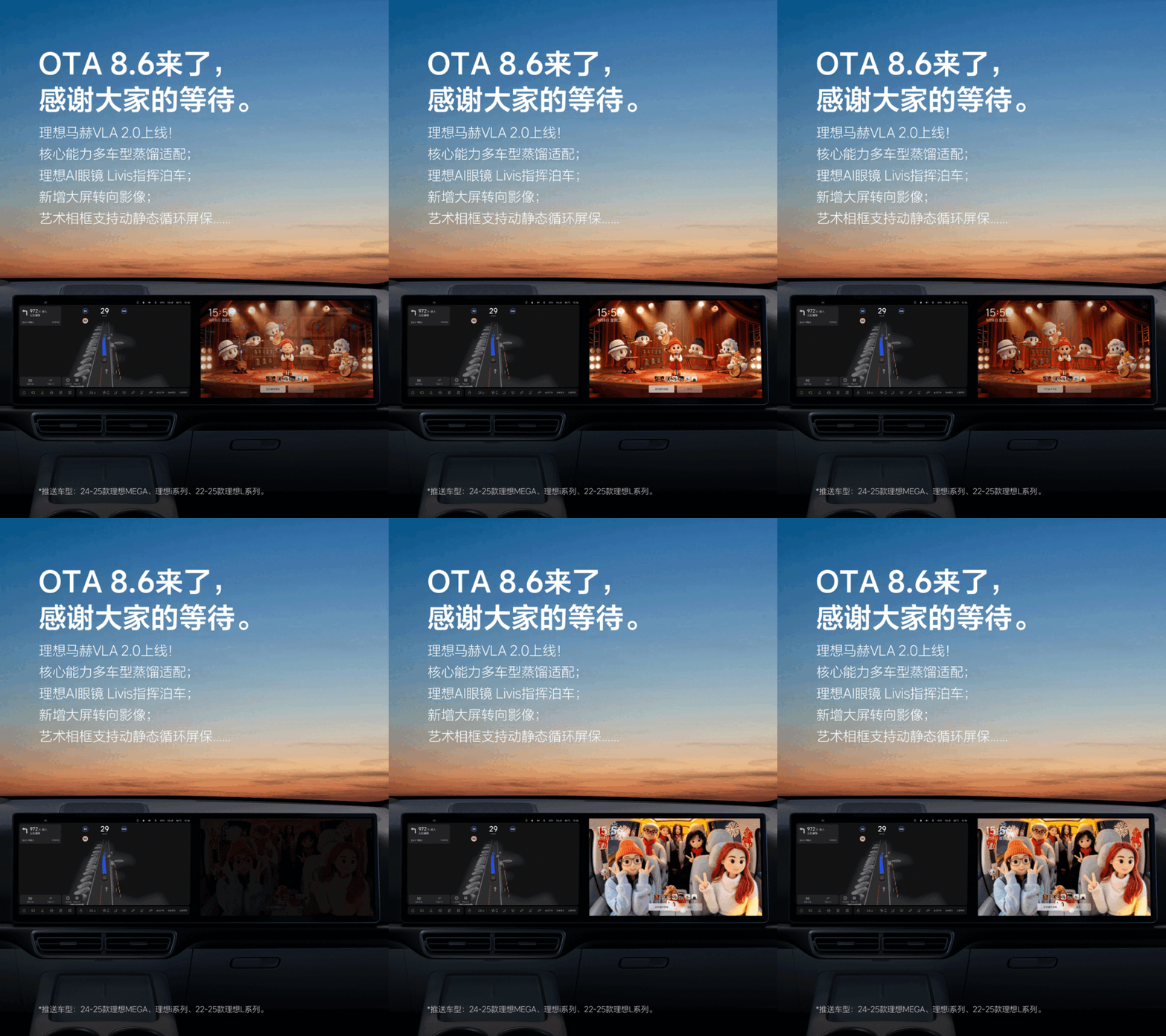
Li Auto announced on September 10 that it has officially begun pushing OTA 8.6 and OTA 9.1.1 vehicle software updates. The biggest highlight is that OTA 8.6 brings Li Auto Mach VLA 2.0 online simultaneously on both the Orin-X and Thor-U chip platforms, covering 2022 through 2025 model year AD Max vehicles and reaching nearly one million existing owners.
In an industry where hardware is typically locked in at the moment of purchase, and where a car’s driver-assistance capability is often fixed once sold, Li Auto chose instead to push its newest VLA large model into older owners’ vehicles fully and without reduction, achieving what the company frames as a cross-generation upgrade.
Cross-Platform Deployment Is Not a Copy-Paste Job
Fitting a new large model onto older chips presented significant technical difficulty. Thor-U supports FP4/FP8 precision, while Orin-X relies mainly on INT8, meaning the underlying operators, memory architecture, and software stack differ completely between the two platforms. According to Li Auto, this required a full redesign rather than simply compiling the same model twice.

Li Auto’s approach was to first train a “teacher model” in the cloud, then use OPD technology to let the vehicle-side “student model” learn along its own driving trajectory, with the teacher model correcting deviations. The update went through algorithm evaluation, simulation, real-vehicle testing, and multi-city generalization testing before release. According to official data, safety performance across the two platforms is 100 percent aligned, with no reduction in functionality; the only difference lies in frame-rate performance caused by the underlying chip hardware.
Detours and Lane Changes Feel More Like an Experienced Driver, Parking by Voice Command
In practical use, Li Auto Mach VLA 2.0 makes the vehicle behave more naturally when navigating around temporarily stopped vehicles or negotiating lane changes. Detour maneuvers are more proactive rather than freezing in place. Lane changes proceed without hesitation, seizing a safe opportunity in one motion. Following behavior is described as more responsive, with more natural negotiation in traffic, giving the car a driving character closer to an experienced driver. Navigation deviation recovery has also improved, allowing the system to automatically replan the assisted-driving route if the vehicle goes off course.
Parking gained new capabilities as well. A new “remote parking out with remote wake-up” feature lets the driver wake the vehicle in advance through the app; approaching the car within five minutes and connecting via Bluetooth allows the driver to walk away directly, eliminating the need to stand in front of the car waiting. A new “command parking” feature supports controlling the vehicle’s parking in, parking out, and straight-line summon from outside the vehicle using Li Auto’s Livis AI glasses and the Li Tongxue app.
Cabin and Electric Systems: Emotional Touches and Practical Savings
Following the earlier pet photo frame feature that resonated widely with owners, the art photo frame has been upgraded again. It now supports mixing photos and videos, with up to 10 sets of material used to generate a dynamic and static looping screensaver, allowing owners to bring memories of multiple pets into the car at once.
The intelligent cockpit also gains a large-screen steering camera view and the ability to upload high-risk Sentry Mode multi-view footage to the app.
On the electric side, the update brings a summer range upgrade, including new end-stage temperature control shutoff and reserve battery pre-cooling, along with multi-time-slot scheduled charging aimed at lowering travel costs.
OTA 9.1.1 Brings Active Suspension Gaming to 2026 Models
OTA 9.1.1 targets new 2026 model year vehicles equipped with Li Auto’s intelligent chassis system, adding active suspension gaming support for titles including Ridge Racer-style treasure hunt games and Forza Horizon 5. While the vehicle is stationary, the chassis suspension provides real-time physical feedback matching the vehicle’s movement within the game, a feature the article describes as a showcase easter egg combining chassis hardware with cabin technology.
Hardware configuration is fixed at the moment of purchase, but the intelligent experience can keep growing through OTA updates. Pushing the newest large model to nearly one million users through cross-platform reconstruction, without leaving older owners behind, relied on five in-house capabilities at Li Auto: its self-developed AI models, its Harness framework, a self-developed operating system, an in-house compiler team, and self-developed chips. As Li Auto’s Li Xiang has said, delivery is not the end point of the product experience. This update gives older owners a real sense that the car keeps feeling new, even with everyday use.