

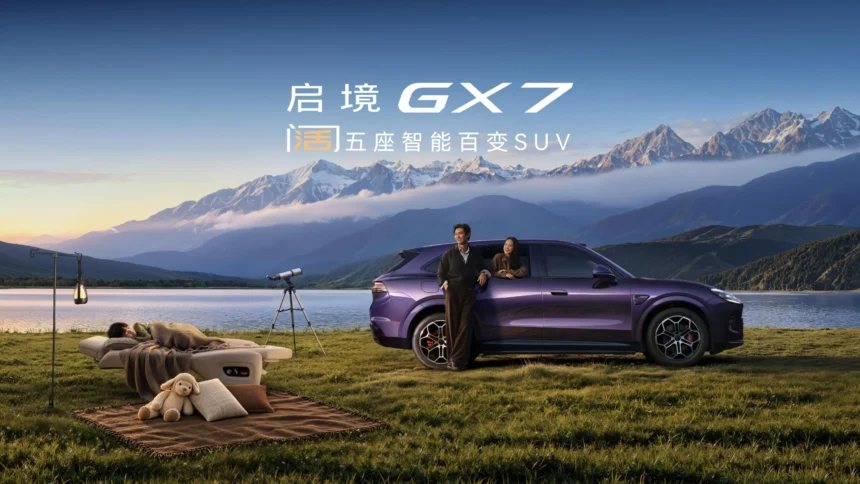
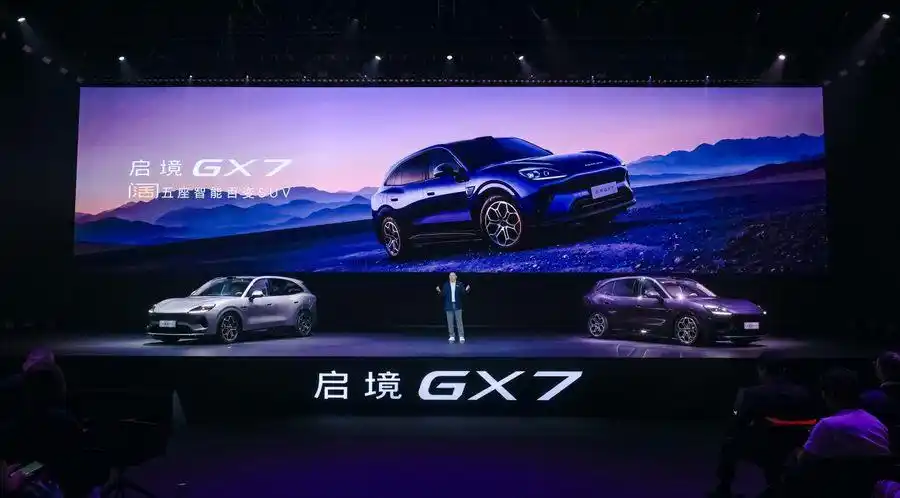
On September 23, Aistaland officially launched the GX7, its first SUV, in three versions: Ultra, Ultra dual-motor AWD, and Ultra tri-motor AWD. Official guide prices for the three trims are 239,900、259,900 and 301,900 yuan ($35,806、$38,791 and $45,060), while limited-time benefit prices are 229,900、249,900 and 291,900 yuan ($34,313、 $37,299 and $43,567).
As Aistaland’s first SUV, the GX7 is positioned as a large range-extender SUV built around the everyday travel needs of families. The vehicle combines a 20-second one-button flat-bed seating mode, an architecture designed for L3-level autonomous driving, a range-extender powertrain and a smart cockpit to explore what a large SUV can offer in terms of space and intelligence.
20-Second Flat-Bed Seating Turns the Cabin Into a Living Space
For family users, a large SUV needs to carry multiple passengers and also adapt to everyday life scenarios beyond driving.
The Aistaland GX7 measures 5,099 mm long, 2,006 mm wide and 1,750 mm tall, with a 3,070 mm wheelbase. At over 5 meters, the body provides the basis for interior space, while a low, wide stance, a two-section roofline and sportier body proportions are used to reduce the visual bulk of the vehicle.
According to Aistaland, the GX7 uses what the company describes as the industry’s first 20-second one-button flat-bed design. A four-fold seat structure, a multi-link lifting mechanism and folding headrests work together to transform the rear seats, forming a 180-degree flat surface within 20 seconds.
Once deployed, the flat-bed space still retains some storage capacity and is equipped with a bedside table, charging ports and lighting. It also offers a 32-point full-body massage function and seat ventilation and heating.
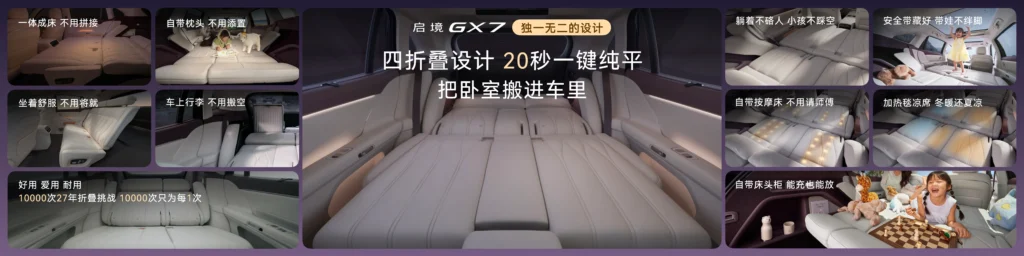
Beyond the rest mode, the GX7 supports more than 12 space modes covering scenarios such as napping, watching movies, caring for children and camping. For a five-seat SUV, Aistaland says the GX7 is intended to solve how interior space is used, so the cabin can adapt to more family life needs.
L3-Ready Architecture and ADS 5 Extend the Driving-Assistance System
Autonomous driving is a key focus for the GX7. The entire lineup uses an architecture designed for L3-level autonomous driving, with redundancy built into eight core systems: power supply, steering, braking, communication, positioning, computing, perception and interaction.
For perception hardware, the GX7 is equipped with four lidar units, including one 896-line dual-optical-path, image-grade lidar, along with five 4D millimeter-wave radars, for a total of 38 perception hardware components forming a multidimensional sensing system.
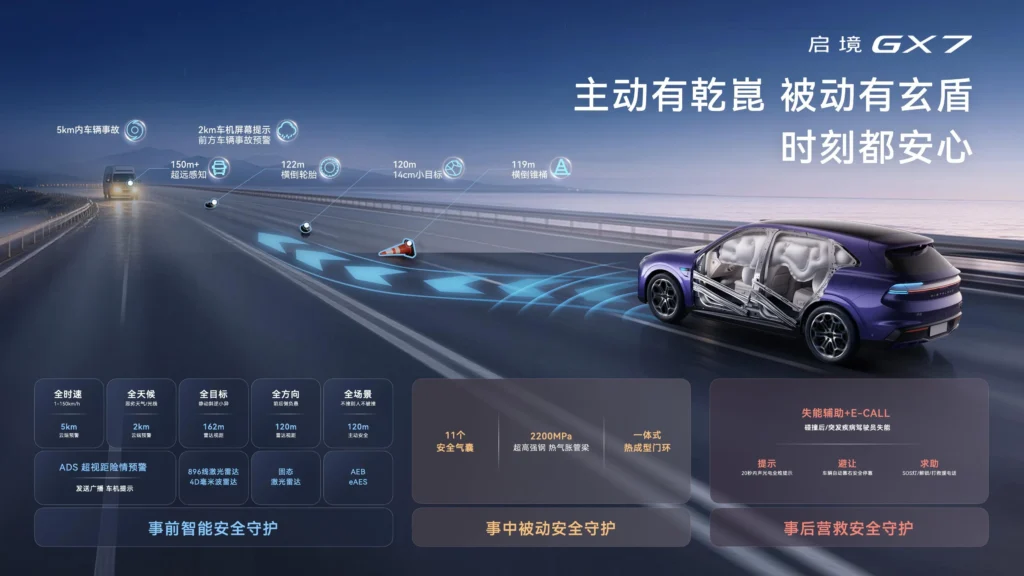
For driver assistance, the GX7 is equipped with Huawei’s Qiankun ADS 5 system, which supports Parking-to-Parking 3.0 and smart parking functions. For scenarios common to urban families, the vehicle supports narrow-road passing assistance and gesture-based parking exit, intended to keep a vehicle longer than 5 meters convenient to use in city environments.
On safety, the GX7 uses what Aistaland calls a Xuandun cage-type body structure, with high-strength steel and aluminum alloy accounting for 90.3% of the body, and a 2200 MPa hot-formed tube beam in the A-pillars. All trims come standard with 11 airbags.
Three Powertrain Versions Deliver Up to 385 km of Electric Range
All three Aistaland GX7 versions use a 1.5T range-extender powertrain, offered as a single-motor rear-wheel-drive, a dual-motor all-wheel-drive and a tri-motor all-wheel-drive setup.
The Ultra version has a maximum power output of 200 kW, accelerates from 0 to 100 km/h in 7.6 seconds, and carries a 52 kWh lithium iron phosphate battery. It has a CLTC pure-electric range of 340 km, equivalent to an estimated 272-289 km on a WLTP basis, a combined range of 1,580 km, and fuel consumption of 5.75 L/100 km at minimum state of charge.
The Ultra dual-motor AWD version has a maximum power output of 340 kW, accelerates from 0 to 100 km/h in 4.9 seconds, and carries a 52 kWh lithium iron phosphate battery. It has a CLTC pure-electric range of 325 km, equivalent to an estimated 260-276 km on a WLTP basis, a combined range of 1,500 km, and fuel consumption of 6.05 L/100 km at minimum state of charge.
The Ultra tri-motor AWD version has a maximum power output of 550 kW, accelerates from 0 to 100 km/h in 3.9 seconds, and carries a 67 kWh ternary lithium (NCM) battery. It has a CLTC pure-electric range of 385 km, equivalent to an estimated 308-327 km on a WLTP basis, a combined range of 1,530 km, and fuel consumption of 6.15 L/100 km at minimum state of charge.
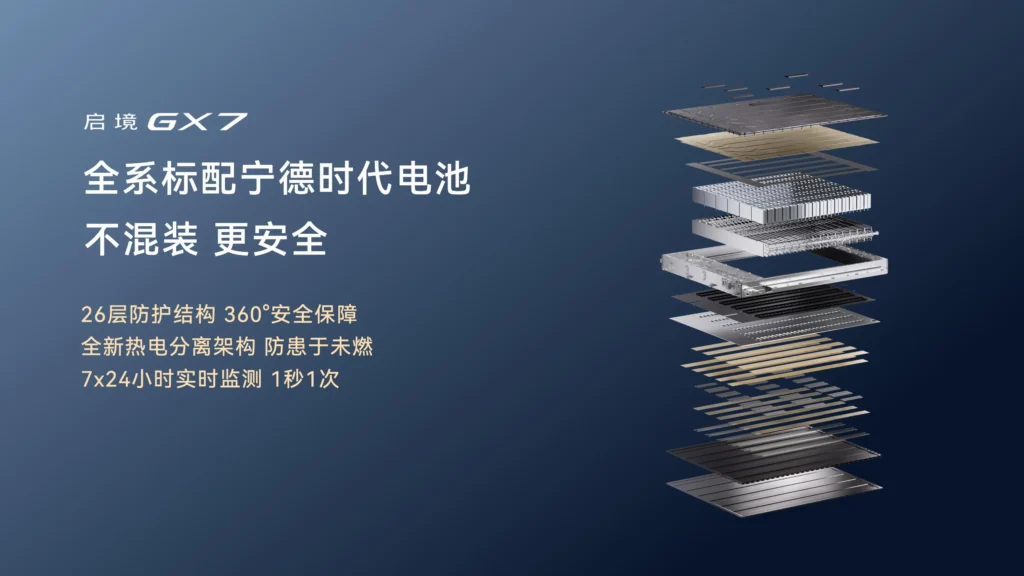
The GX7 uses CATL’s Qiaoyao battery, offered in 52 kWh and 67 kWh capacities depending on the version. The tri-motor AWD version uses an 800V high-voltage platform and supports 5C super-fast charging, with a 30%-80% charge taking as little as 10 minutes; the other versions take about 15 minutes for the same 30%-80% charge.
On battery safety, the vehicle uses a 26-layer protective structure, a dual-layer ultra-high-strength steel guard plate and a thermal-electric separation architecture, along with 24/7 real-time monitoring.
For the chassis, the GX7 uses Huawei’s Qiankun Chitu platform with a six-in-one full-domain fusion architecture, an all-aluminum rear H-arm suspension, a dual-chamber closed-type air suspension and continuously variable damping shock absorbers, with an AI suspension system for road-condition sensing and dynamic adjustment.
Full-Stack Intelligence Spans the Cockpit and Onboard Ecosystem
Beyond driver assistance, the GX7 is equipped with seven of Huawei’s automotive intelligence solutions, covering driver assistance, cockpit, chassis, vehicle lighting, communication, vehicle-cloud connectivity and electric drive.
In the cockpit, the GX7 is among the first vehicles equipped with HarmonySpace 6. The front row features dual 15.6-inch Huawei smart displays with NFC-based seamless transfer, while the rear seats get a 32-inch 2K laser projection screen with low-blue-light certification.
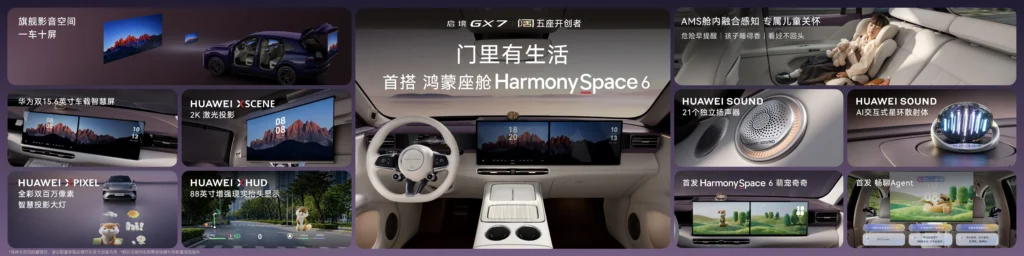
The vehicle also supports a magnetic folding lens that creates a 46-inch open-air giant screen, paired with the HUAWEI SOUND audio system, 21 independent speakers and a 7.1.4 surround sound field for an in-car entertainment experience.
On smart interaction, the GX7 debuts a pet-themed mascot called “Qiqi” and is equipped with a Changliao Agent smart assistant that can handle navigation, vehicle control and food-ordering functions.
In addition, the AMS in-cabin fusion perception system supports warnings for dangerous movements by children, anti-pinch seat protection and adjustable child sleep modes.