

BYD, MG, and GWM buyers encounter 30–100% higher premiums despite competitive pricing
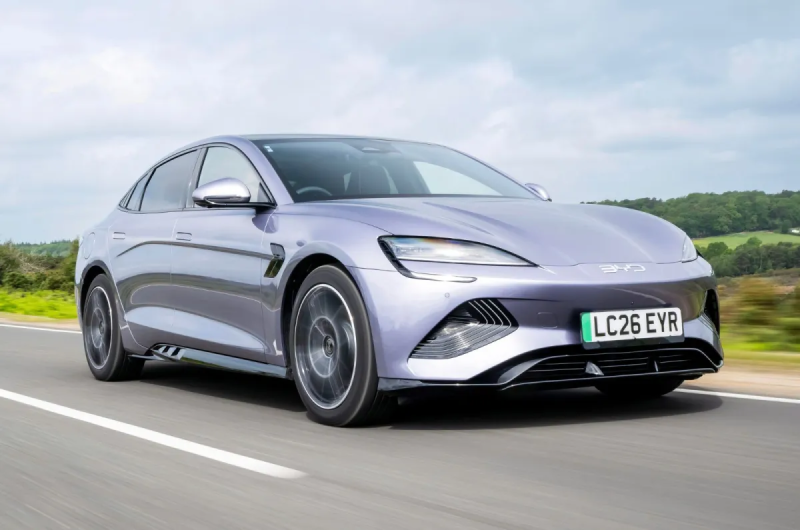
Chinese battery-electric vehicle manufacturers have rapidly gained market share in Europe and the UK by offering advanced specifications and competitive pricing, BYD, MG and Ora brand now compete directly with established automakers on range and technology, often undercutting European rivals on sticker price.
- BYD, MG, and GWM buyers encounter 30–100% higher premiums despite competitive pricing
- Four Cost Drivers Behind the Premium Surge
- Insufficient actuarial claims history
- UK Market: Thatcham Ratings and Coverage Gaps
- EU Market: Fragmented Systems and Monopoly Repair Costs
- Side-by-Side Comparison: Chinese EVs vs. European Petrol Cars
- Pathways to Lower Premiums
- OEM-backed insurance products
- European regional parts hubs
- Battery module inspection and partial-repair standards
- Conclusion
But buyers are discovering a significant hidden cost at the point of insurance. Annual premiums for Chinese EVs in the UK and across the EU typically run 30% to 100% higher than comparable European conventional vehicles, and some models face outright coverage refusals from major insurers on comparison sites. In several cases, the insurance premium differential erases much of the purchase-price advantage within the first ownership cycle.
The root cause is not vehicle defects or quality issues. Instead, insurers cite a structural mismatch: Chinese automakers have accelerated market entry faster than they have built the aftersales ecosystems—parts distribution, certified repair networks, and claims data—that underpin accurate actuarial pricing in mature markets.
Four Cost Drivers Behind the Premium Surge
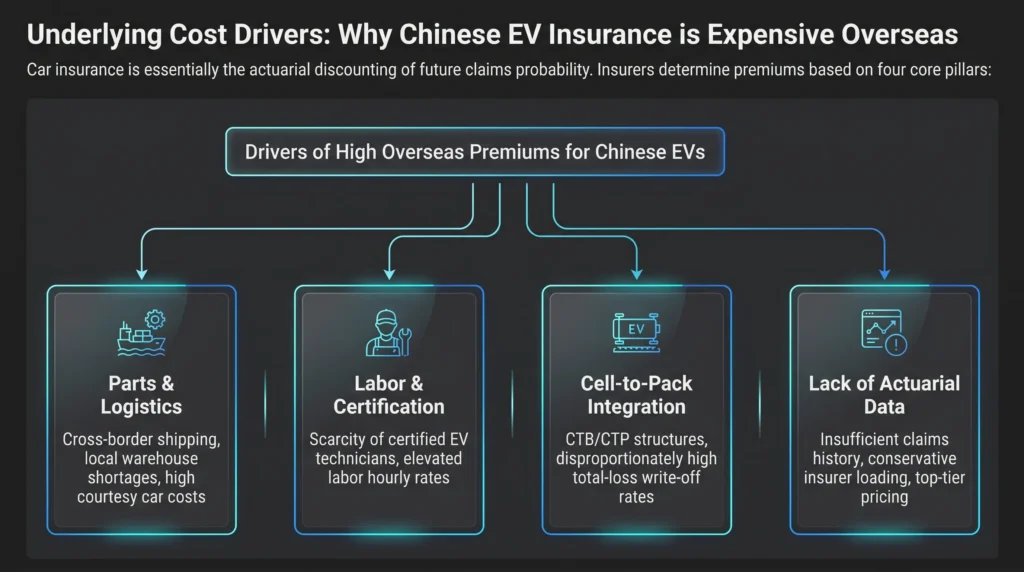
Insurers calculate premiums by estimating future claim costs across four key variables: parts availability, labor qualifications, total-loss thresholds, and historical loss data.
Parts supply-chain gaps
European parts networks for Volkswagen, Stellantis, and BMW brands have evolved over decades. Aftermarket suppliers deliver most body panels and consumables within 24 to 48 hours. Chinese EV makers, by contrast, are still establishing regional distribution hubs. Non-standard body panels, door assemblies, and proprietary wiring harnesses often ship from China, extending repair times to four to eight weeks for minor collisions.
During that wait, insurers must cover courtesy-car rental costs, which in the UK commonly reach £40 to £80 per day. On a six-week repair, rental expenses alone can exceed the cost of the damaged parts, directly inflating claim severity.
High-voltage repair qualification shortages
Servicing 400V and 800V battery systems requires technicians to hold specific safety certifications—IMI Level 3 or Level 4 in the UK, DGUV 209-093 in Germany. Most independent body shops lack these credentials and the isolated high-voltage work bays the standards mandate.
Qualified workshops command a 30% to 50% premium on hourly labor rates compared to conventional engine repair, and capacity constraints mean longer turnaround times. Insurers face higher per-claim labor costs and extended rental periods.
Cell-to-pack and cell-to-body architecture raising write-off rates
To maximize range and reduce weight, Chinese automakers have widely adopted [cell-to-pack] (CTP) and [cell-to-body] (CTB) designs, in which the battery pack forms part of the vehicle’s structural chassis. A low-speed kerb strike or side-impact collision that damages the underside of a CTP or CTB vehicle presents a diagnostic problem: there is no industry-standard method to non-destructively assess individual cell integrity or detect microfractures that could lead to thermal runaway.
Facing liability risk and lacking repair protocols, insurers frequently declare such vehicles total losses even when surface damage appears repairable. The resulting jump in total-loss frequency significantly raises expected claim costs.
Insufficient actuarial claims history
European and UK insurers rely on decades of claims data—covering tens of millions of vehicles—to model loss frequency, repair costs, and theft rates. Most Chinese brands entered Europe in volume only after 2021. Actuaries lack long-term statistical baselines for these models.
In the absence of robust data, underwriters apply risk-loading penalties, effectively assuming worst-case loss scenarios and pricing policies at the upper end of the feasible range.
UK Market: Thatcham Ratings and Coverage Gaps
The UK operates one of the world’s most rigorous insurance-rating systems. [Thatcham Research] assigns every new model to one of 50 insurance groups based on passive safety, repair costs, and security features. The group rating directly determines baseline premiums.
Thatcham’s evaluation includes a 15 km/h low-speed crash test designed to measure urban-collision repairability. Early Chinese EV submissions encountered obstacles: some manufacturers did not initially provide Thatcham with localized repair manuals or itemized labor schedules. When a minor front-end impact requires replacement of an entire integrated bumper assembly—including radar sensors and high-resolution cameras—rather than modular components, Thatcham assigns a higher group rating, typically Group 35 to 45, placing the vehicle in a high-risk premium band.
UK insurers such as Admiral, Aviva, and Direct Line integrate vehicle data through the ABI code system. New Chinese models often appear late in insurer databases. On aggregator platforms like Compare the Market, buyers frequently encounter “vehicle not found” errors or receive quotes from only one or two specialty underwriters, eliminating price competition.
Sample UK annual premiums (35-year-old driver, clean record, comprehensive cover):
- [MG4 EV]: £800 to £1,100. MG benefits from legacy Rover dealership and parts infrastructure in the UK, resulting in relatively stable premiums.
- [BYD Atto 3] / [BYD Seal]: £950 to £1,450. High-performance dual-motor variants enter Group 38 and above.
- Comparable petrol vehicle (Volkswagen Golf 1.5 TSI): £600 to £750.
EU Market: Fragmented Systems and Monopoly Repair Costs
The European Union does not use a unified insurance-group model. Instead, national trade associations maintain separate rating indices—Germany’s GDV Typklassen system (scale 10 to 25) and France’s SRA ratings, for example.
Liability versus comprehensive coverage splits
Third-party liability premiums (Haftpflicht in Germany, Responsabilité Civile in France) remain similar between Chinese EVs and conventional vehicles. Liability rates are driven primarily by driver age, experience, and no-claims history.
The gap widens sharply in comprehensive own-damage cover (Vollkasko). EV comprehensive premiums average 35% or more above petrol equivalents, reflecting the high cost of recalibrating [ADAS sensors]—lidar and radar units can cost over €1,000 to replace and recalibrate—and the expense of replacing panoramic glass roofs, which are common on Chinese EV models.
Independent repair access constraints
The EU Motor Vehicle Block Exemption Regulation requires automakers to share diagnostic protocols with independent repairers. However, some Chinese manufacturers have been slow to localize software interfaces and diagnostic tools for European independent workshops. Accident-damaged vehicles often must go to a small number of authorized flagship service centers, which face limited price competition and can set higher labor rates. These monopoly repair costs feed directly into insurers’ claims expenses.
Sample German annual comprehensive premiums:
- Conventional European SUV (Volkswagen Tiguan 2.0 TSI): €650 to €850
- Chinese compact/midsize EV ([BYD Atto 3] / [GWM Ora 03]): €1,000 to €1,400
Side-by-Side Comparison: Chinese EVs vs. European Petrol Cars
| Dimension | European Petrol Cars | Chinese BEVs (BYD, MG, GWM) | Business Impact |
|---|---|---|---|
| Average annual premium | Baseline (£600–£750 / €600–€800) | 30% to 70% higher (£900–£1,450+ / €1,000–€1,500+) | Fuel savings partly offset by insurance costs |
| Minor collision repair time | 3 to 7 days average | 15 to 45 days average (transoceanic parts shipment) | Extended courtesy-car costs; owner inconvenience |
| Total-loss threshold | Repair cost reaches 65–75% of residual value | Chassis deformation often triggers immediate write-off | Accelerated depreciation; increases GAP insurance need |
| Performance and actuarial risk perception | 0–100 km/h in 8–10 seconds; gradual power delivery | Single-motor instant torque; 0–100 km/h in 4–6 seconds | Actuaries view first-time EV drivers as higher-risk |
| Parts supply autonomy | Highly modular; widespread aftermarket availability | OEM-only single-source channels; no price competition | Insurers cannot substitute third-party generic parts to control claim costs |
Pathways to Lower Premiums
High insurance costs represent a regulatory and infrastructure hurdle Chinese automakers must clear to establish themselves in Europe’s mature markets. Price reductions and battery capacity alone will not resolve the issue. Several improvement trends are now emerging:
OEM-backed insurance products
[BYD] and [MG] have begun partnering with European insurers including Allianz and Octopus Insurance to offer manufacturer-backed policies. These products bundle parts-supply guarantees and certified repair networks, bypassing the risk premiums independent insurers apply to unfamiliar brands.
European regional parts hubs
SAIC and [BYD] have opened central parts warehouses in Amsterdam and Belgium. These facilities stock high-turnover body panels and consumable components, reducing delivery times for common repairs to 48 to 72 hours.
Battery module inspection and partial-repair standards
Independent third-party battery testing organizations are developing rapid post-impact cell-integrity assessment protocols. These standards aim to replace the current blanket total-loss practice with targeted module replacement, preserving vehicle value and reducing claim severity.
Conclusion
The insurance-cost gap facing [Chinese electric vehicles] in Europe is not fundamentally a product-quality issue. It is a market-maturity problem. Chinese automakers accelerated product launches ahead of the supporting logistics, training, and data infrastructure that European brands built incrementally over decades.
Total cost of ownership parity will require full localization: regional parts distribution, broad independent-repair certification, and multi-year claims databases. Only when those three pillars are in place will [Chinese EV] buyers in the UK and EU achieve insurance premiums comparable to established brands. Until then, the hidden insurance premium remains a significant friction point in Chinese automakers’ European expansion.